
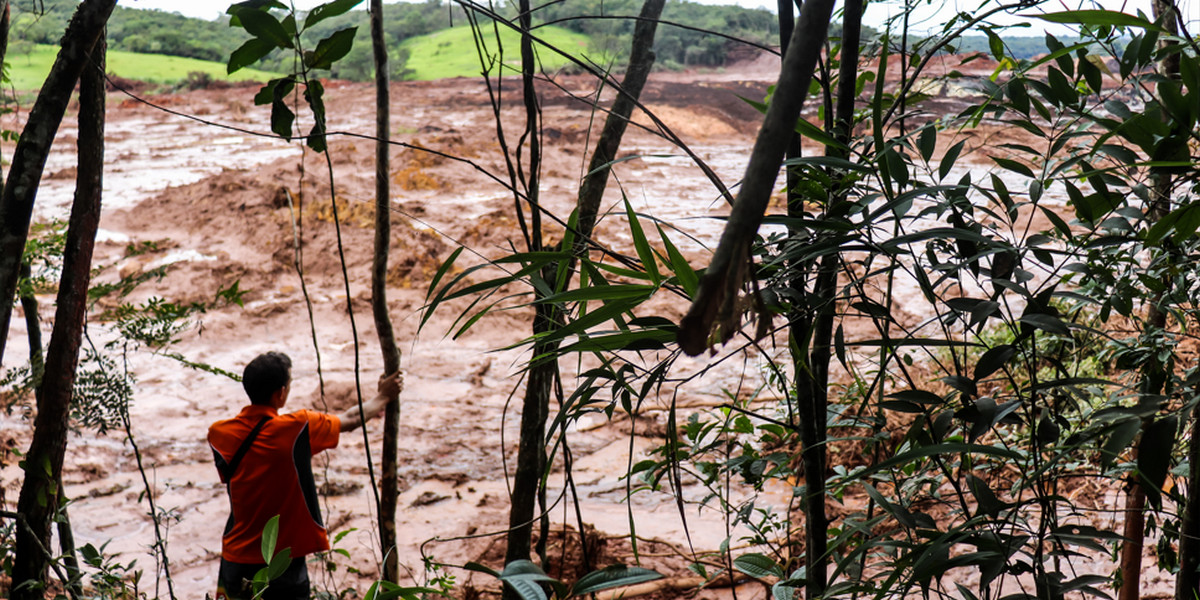
Honoring victims and calling to prevent another tragedy
On January 25, 2019, the collapse of a tailings dam at Vale S.A.’s Córrego do Feijão mine in Brumadinho, Minas Gerais, resulted in 272 fatalities. The majority were workers—employees of Vale and its contractors—caught in one of the deadliest workplace tragedies in recent history. Families lost loved ones, communities were shattered, and Brazil faced the painful reality of unsafe extractive practices. Every year since the disaster, CIDSE has joined victims’ families and affected communities in remembering the tragedy, honouring those who lost their lives and reaffirming the collective responsibility to ensure that such a catastrophe is never repeated.
The disaster’s effects went well beyond loss of life. Millions of cubic meters of toxic mining waste threatened homes, farmland, and infrastructure, contaminating the Rio Paraopeba and endangering water supplies for many downstream communities. For many locals, the aftermath of Brumadinho has meant ongoing health concerns, disrupted livelihoods, and a persistent struggle for justice and fair reparations.
Today, as we remember the victims, their memory drives us to not only mourn but also to question current safety measures. Recent reports from the same mining site where the tragedy occurred raise serious concerns about whether lessons from 2019 are being applied. CIDSE and its member organisations have closely followed developments in the Brumadinho region since the disaster, maintaining ongoing engagement with civil society partners and monitoring new risks faced by workers and communities.
Investigations by Repórter Brasil in late 2025 reveal fears among residents of Jangada about the restart and expansion of mining at the Jangada Mine, located within the same complex as Córrego do Feijão. This mine is now operated by Itaminas Mineração S.A., under a concession formerly held by Vale. Locals worry that renewed activity could deplete and contaminate vital springs and groundwater, essential for drinking, farming, and daily life, risking health, food security, and potentially displacing entire communities.
These worries are longstanding. Reports show the Jangada community has already asked the Ministério Público to permanently shut down the mining complex as part of the reparations owed after 2019. For those living with the consequences of Brumadinho, permitting mining to restart feels more like repetition than recovery.
Meanwhile, concerns are growing about the integrity of environmental regulation in Minas Gerais. Another investigation by Repórter Brasil in October 2025 highlights fears of regulatory capture, following the appointment of an ex-state prosecutor—who previously represented mining companies—as head of FEAM [1]. Such appointments threaten public confidence and weaken oversight when strict regulation is crucial to prevent further tragedies.
These local issues are part of a larger global picture. Research highlighted by the Business & Human Rights Resource Centre shows Brazil, as a key producer of “transition minerals,” faces growing pressure to expand mining to meet global energy transition needs. Without strong safeguards, transparency, and respect for human rights, this expansion risks repeating patterns of environmental harm, labor exploitation, and community displacement that caused tragedies like Brumadinho.
Resuming mining activities at Jangada under these conditions directly conflicts with the core principle of non-repetition. Honoring the 272 lives lost means preventing similar risks for communities and workers, and respecting victims’ families and communities, who continue to demand truth, justice, full reparations, and assurances that such a disaster will never happen again.
Remembering Brumadinho is not only about honouring the past; it is a call to act decisively in the present. Yet today, these protections face renewed threats. Brazil’s Congress has recently approved legislation rolling back environmental protections for mining, infrastructure, and agricultural projects, overriding a partial presidential veto only days after the conclusion of COP30. This move, which may now be contested before the Supreme Court, risks further eroding environmental governance and accountability at a moment when vigilance is most needed. As Brazil faces mounting pressures linked to climate change and mineral extraction, the memory of Brumadinho must be honoured as both a warning and a guide, reminding us that justice, strong institutions, and respect for human life and nature are indispensable to ensuring that such loss is never repeated.
[1] Fundação Estadual do Meio Ambiente (State Foundation for the Environment)
Contact: Susana Hernández Torres, Corporate Regulation Officer, CIDSE (hernandez(at)cidse.org)
Cover photo: Brumadinho, MG, Brazil, 2019. Credit: Mídia NINJA, CC BY-NC-SA 2.0