
11TH SESSION OF THE OPEN-ENDED INTERGOVERNMENTAL WORKING GROUP ON TRANSNATIONAL CORPORATIONS AND OTHER BUSINESS ENTERPRISES WITH RESPECT TO HUMAN RIGHTS
CONCLUSIONS FROM CIDSE AND ITS MEMBER ORGANISATIONS
1. OVERVIEW
The 11th session of the OEIGWG, mandated under Human Rights Council resolution 26/9, signified a significant qualitative and political advancement in the decade-long endeavour to establish a legally binding instrument concerning transnational corporations and other business enterprises (TNCs and OBEs).
According to the report A/HRC/61/XX, a total of 63 States participated, including new or re-engaged actors, reflecting a growing global ownership of the process.
Under the leadership of Chair-Rapporteur Marcelo Vázquez Bermúdez, this initiative has advanced over the past two years through a participatory methodology that includes intersessional thematic consultations and negotiations led by States. Additionally, the Chair submitted a report with wording proposals for some provisions of the Articles discussed during the 10th session and the intersessional thematic consultations, where convergence was achievable. Although this report does not replace the updated draft, it demonstrates the Chair’s willingness to progress in negotiations more efficiently. During the 11th session, States completed the review of the entire updated draft.
“After more than a decade of work, the process has reached a decisive phase. We must translate momentum into lasting results.”
Ambassador Marcelo Vázquez Bermúdez, Chair-Rapporteur.
2. REGIONAL AND POLITICAL DYNAMICS
The 11th session witnessed an increased participation from Arab States, urging alignment with existing international commitments when the trade and investment provisions where discussed (Article 14),
On the other hand, Mexico, Uruguay, Colombia and Palestine continue advancing progressive proposals consistent with civil-society calls. For instance, Mexico supported the reintroduction of Article 14.5 bis, confirming the primacy of human rights obligations over trade and investment agreements, a reform endorsed by CIDSE’s legal analysis.
As it has been urged by civil society and social movements throughout these years, many delegations emphasised the necessity for the instrument to be rooted in human rights and to adopt a victim-centred approach. Other States advocated for a realistic and implementable LBI, aiming to avoid disproportionate burdens on developing countries while ensuring accountability and access to remedies.
The European Union, as has been customary in previous years, attended the 11th session and provided comments and recommendations on nearly all provisions discussed in the updated draft (12-24). This also included participation in the interactive discussion of the Chair’s wording proposals concerning certain provisions from 4 to 11. In their general statement, they highlighted the ongoing modifications to the EU CSDDD under the Omnibus I and, as in previous years, expressed the absence of a formal negotiating mandate.
3. CIDSE DELEGATION AT THE 11TH SESSION
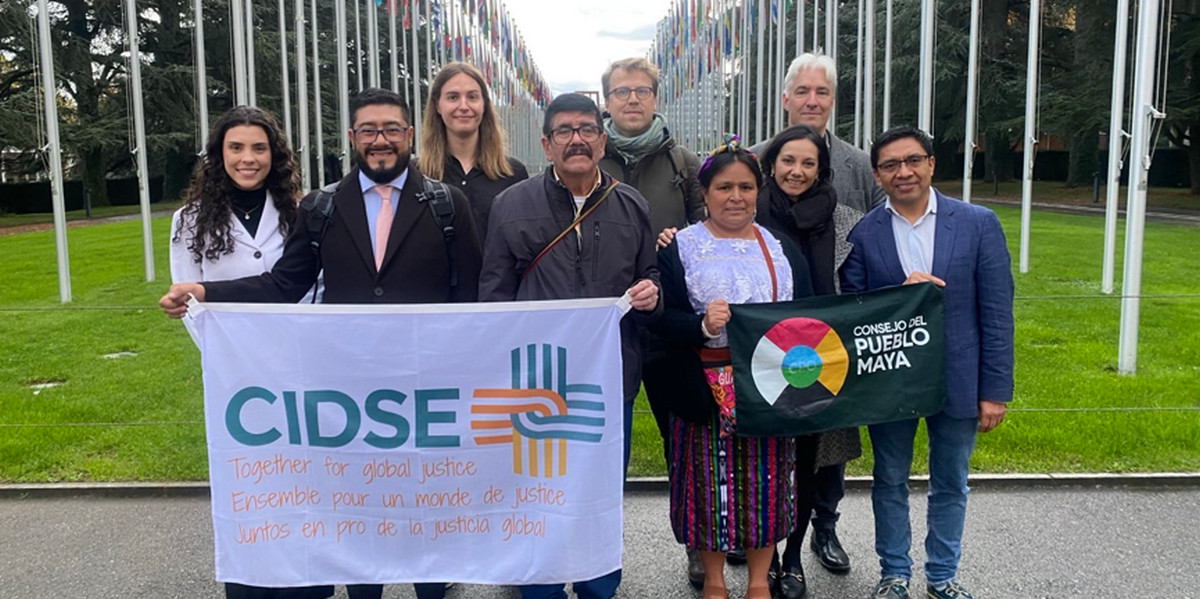
This year, the CIDSE delegation comprised members Trócaire, Broederlijk Delen, Fastenaktion, and DKA Austria, as well as partners COPAE, the Xinka Parliament, and the Consejo de Pueblos Maya from Guatemala, along with the Human Rights Clinic of the Federal University of Minas Gerais, Brazil. The CIDSE delegation actively contributed through joint statements and article-specific recommendations.
CIDSE partners from Guatemala, COPAE, the Xinka Parliament, and the Consejo de Pueblos Maya, delivered compelling interventions in an opening statement, Articles 8 and 14, highlighting the lived experiences of communities impacted by corporate abuses.
4. NEGOTIATION PROGRESS AND SUBSTANTIVE OUTCOMES
The session reviewed Articles 12–24 and debated 13 wording proposals by the Chair (Articles 4–11). According to the report A/HRC/61/XX, some of the key areas of convergence and contention included:
| 6 (Prevention) | Robust prevention obligations | Explicit reference to the protection of the environment, with some requesting such references to be added throughout the instrument. |
| 7 (Access to Remedy) | Removing barriers for victims. | Removal of qualifiers related to domestic law |
| 8 (Legal Liability) | Accountability of natural and legal persons. | Wide support for Article 8.6 bis, introducing joint and several liability for parent companies across global value chains. |
| 9 (Jurisdiction) | Preventing denial of justice. | Emerging consensus on forum necessitatis (Article 9.4 bis) allowing jurisdiction where victims otherwise lack access to courts. |
| 10–11 (Limitation Periods & Applicable Law) | Alignment with international law and victim-friendly standards. | Calls for longer limitation periods and application of the law most favourable to victims. |
CIDSE particularly appreciates the efforts made by the Chair to incorporate our requests already reflected in the report. Specifically, this includes strengthening the provisions in Article 6.2 through the integration of the concept of free, prior, and informed consent; replacing the word “reduce” with “remove” in Article 7.2(b); and seeking the deletion of the word “progressively.” Additionally, CIDSE questioned the list of crimes enumerated in Article 10.1 to ensure the provision remains as inclusive as possible, reflected adequately in the report. Likewise, the changes to Article 11, to ensure that victims can rely on the law most favourable to their case.
Other significant points raised during the discussion of Articles 12–24 included the repeated opposition from Gulf States to any references to sexual orientation and gender identity (SOGI), as well as a concerted effort by several delegations to challenge the provisions on corporate capture outlined in Article 16(6). These interventions reflected broader tensions within the negotiations, highlighting both the persistent resistance to SOGI-related language and the growing scrutiny of mechanisms intended to address corporate influence in human rights processes.
5. CHAIR’S RECOMMENDATIONS AND THE 2026 ROADMAP
The Chair-Rapporteur’s conclusions, adopted ad referendum, set out a clear next phase:
- States and stakeholders to submit written contributions on Articles 4–11 by 1 February 2026.
- 2026 Roadmap to implement Human Rights Council Decision 56/116, including three intersessional thematic consultations and preparations for the 12th session (19–23 October 2026).
- Strengthened use of Friends of the Chair and legal experts to deepen convergence and inclusivity.
- Continued emphasis on a State-led but inclusive negotiation process, with active engagement from civil society and affected communities.
6. FINAL NOTE
The 11th session reaffirmed that progress, though incremental, is real. The process now requires sustained political courage, cross-regional alliances, and civil society vigilance to deliver a treaty that transforms moral commitment into legal accountability.
“The negotiations are now going into their twelfth year, and we would like to see the day when an ambitious instrument is adopted. Affected individuals and communities, particularly workers, children, women, human and environmental rights defenders, peasants and other people working in rural areas, Indigenous Peoples, people affected by armed conflict and occupation, as well as the environment urgently need an effective instrument to stop corporate impunity.” [1]
[1] Joint closure statement by the Treaty Alliance, the Global Campaign, Feminists for a Binding Treaty and ESCR-Net (*Joint statement presented by the broadest coalition of civil society networks and social movements committed to a strong binding treaty).
Additional information:
- CIDSE presence and activities at the UN OEIGWG 11th Session, October 2025
- IGWG11: UN continues negotiations on treaty for transnational corporations, Franciscans International, 5 November 2025
- Hope in Dark Times? Key Takeaways from the 11th Session of Negotiations for a UN Treaty on Business and Human Rights,Trócaire, 2 December 2025
Contact: Susana Hernández Torres, Corporate Regulation Officer, CIDSE (hernandez(at)cidse.org)
Cover image: CIDSE delegation at the UN OEIGWG 11th session, Geneva, 2025.
Credit: CIDSE.