
PRESS RELEASE
Brussels, 22 November 2025
As the dust settles in Belém after two weeks of intense negotiations, CIDSE recognises both the renewed spirit of multilateralism on display and the sobering reality that mechanisms for action still lag behind the urgency of the current climate crisis.
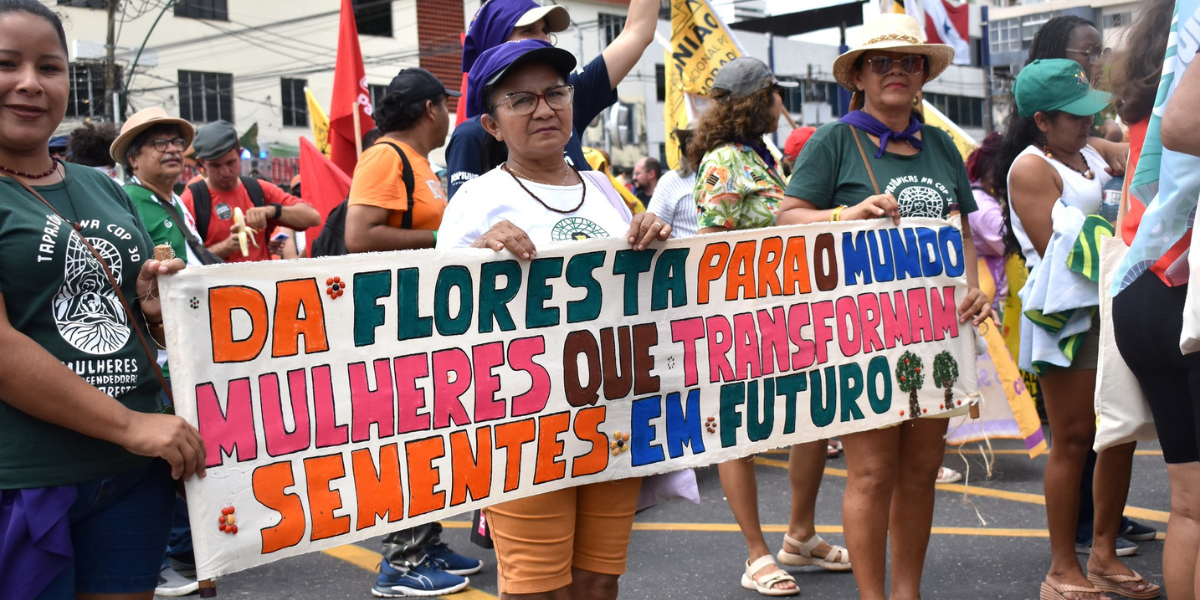
COP30 was marked by the vibrant presence of civil society, indigenous peoples, and local communities reclaiming their place at the centre of climate conversations. The People’s Summit (November 12-16) demonstrated that real change must rise from the ground up – from frontline communities systematically excluded from decision-making spaces – reminding the world that climate justice cannot be separated from social, economic, and ecological justice, nor from ancestral knowledge or nature, as we were constantly reminded in Belém.
A Test of Multilateralism
Despite late nights, contested language, and even an emergency fire evacuation, parties—particularly from the Global South—united behind the Belém Action Mechanism (BAM) as a roadmap for transitioning away from fossil fuels. As Pope Leo XIV stated in his message for COP30: “In the midst of a world that is in flames… this Conference should become a sign of hope, through the respect shown to the views of others in the joint endeavor to search for common language and consensus.” The spirit of multilateralism, tested but not broken, proved resilient.
The Gap Between Vision and Action
Yet while indigenous peoples and affected communities were more visible than ever in Belém, mechanisms to ensure their voices shape outcomes remain inadequate. As a network of Catholic organisations, inspired by Laudato Si’ and Laudate Deum, we can’t accept climate responses that protect the powerful while abandoning vulnerable communities. The climate crisis is inseparable from poverty, inequality, and exclusion. A true response must be an integral one: it protects both people and the planet, builds up the common good, and honors our responsibility to future generations.
The ambition must be greater than ever. And to implement effective climate responses, we must turn away from the current colonial system and address the existing responsibility of wealthy nations which have not been held accountable or acted to alleviate the ecological debt that today is still present in the Global South, which is more vulnerable than ever to climate change.
“A truly fair and just energy transition will only be possible through a deep transformation of our economic system. And if this means a shift in our understanding of growth, then this is the moment to reflect together and act courageously.” commented Josianne Gauthier, CIDSE Secretary General.
“COP30 was hailed as the moment of truth and action. The real truth is we can’t be duped anymore: northern countries have lost the credibility to lead, despite having the greatest capacity and responsibility. Our leaders dodged a firm commitment to transition away from fossil fuels despite the growing demand. But we’ve secured the Belem Action Mechanism (BAM), a just and equitable transition continues, one that ensures no one is excluded or sacrificed politically, socially, or economically in the name of climate ambition and action. That’s people power but we still have a long way to go”, said Lydia Machaka, CIDSE Policy Officer on Energy & Extractivism.
The roadmap from Belém must be paved with concrete commitments, adequate financing – based on grants, not loans -, and structures that center justice and human dignity, keeping the already existing commitments present in the Paris Agreement. Countries need to step up their ambition and immediately establish a mechanism to phase out of fossil fuels. The moment to act is now, not later.
From Belém to the World
The spirit of Belém—of walking together, of centering the excluded, of choosing solidarity over self-interest—must not remain in the Amazon. The earth is crying out. The poor are crying out. Belém heard them. Now the world must act.
NOTES TO THE EDITORS:
CIDSE is an international family of Catholic social justice organisations. We work with global partners and allies to promote justice, harnessing the power of global solidarity to achieve transformational change for people and the planet. We challenge systemic injustice and its destructive impacts through connecting, mobilising, influencing and telling stories of change. We promote environmentally and socially just alternatives to allow everyone to thrivein our common home. CIDSE’s work is guided by Catholic Social Teaching and Gospel values. www.cidse.org
CIDSE members are: Broederlijk Delen (Belgium), CAFOD (England and Wales), CCFD-Terre Solidaire (France), Cordaid (the Netherlands), Development & Peace (Canada), Entraide et Fraternité (Belgium), eRko (Slovakia), Fastenaktion (Switzerland), FEC (Portugal), FOCSIV (Italy), Partage Lu (Luxembourg), KOO (Austria), Manos Unidas (Spain), Maryknoll Office for Global Concerns (USA), MISEREOR (Germany), SCIAF (Scotland), Trócaire (Ireland), Vastenactie (the Netherlands).
For more information about CIDSE activities at COP30, visit our webpage.
MEDIA CONTACTS
– Annia Klein, CIDSE Communications Officer, klein(at)cidse.org
– Lydia Machaka, CIDSE Energy & Extractivism Policy Officer, machaka(at)cidse.org
– Giorgio Gotra, CIDSE Operations & Communications Manager, gotra(at)cidse.org
Additional reactions from CIDSE members:
- CAFOD: What was the outcome at COP30?, 24 November
- CCFD-Terre Solidaire: Après la COP30, garder espoir en se mobilisant face aux injustices, 28 November
- Development and Peace-Caritas Canada : COP30: Development and Peace ― Caritas Canada reaffirms its commitment to global ecological justice (FR), 24 November
- Fastenaktion: COP30: Ein Schritt vorwärts bei Klimagerechtigkeit, Klimaschutz steht aber still, Press release, 23 November 2025 (FR)
- Focsiv: Cop30: il multilateralismo continua lentamente, 24 November
- FEC: COP30 Clima – Mutirão sem rumo, exclui roteiro para abandonar combustíveis fósseis, joint press release with ZERO and Oikos, 22 November.
- KOO: Allianz für Klimagerechtigkeit zur COP30: Gefährlich schwaches Ergebnis und viele enttäuschte Erwartungen, 22 November 2025
- Maryknoll Office for Global Concerns: Maryknoll at COP30 in the Amazon, 5 January 2026
- Misereor: Ein enttäuschendes Ergebnis für die Menschen im Globalen Süden, 22 November 2025
- SCIAF: What happened at COP30?, 9 December 2025
- Trócaire: Corporate lobby the winners at COP as Trócaire slams lack of ambition in the final text, 25 November
Cover photo: COP30, Credit CIDSE