
CIDSE and its members’ written contribution to the Chair-Rapporteur’s suggested redrafting of selected provisions of Articles 4 to 11 of the updated draft of the United Nations (UN) Legally Binding Instrument (LBI) on Business and Human rights
The process towards a UN Legally Binding Instrument (LBI) on Transnational Corporations (TNCS) and other business enterprises with respect to Human Rights represents a landmark effort to address governance and legal gaps to regulate TNCS and other types of business. More than 10 years after the Human Rights Council adopted resolution 26/9 mandating the creation of an Open-Ended Intragovernmental Working Group (OEIGWG), this United Nations process remains a crucial avenue for corporate accountability, particularly for victims and affected communities. The current phase of negotiations, including the Chair-Rapporteur’s suggested redrafting of selected provisions of Articles 4 to 11, offers an important opportunity to enhance legal clarity, coherence and effectiveness while ensuring that the instrument responds meaningfully to the realities of victims and communities impacted by businesses’ operations.
In light of their longstanding commitment to the promotion of human dignity, social justice and care for our Common Home, CIDSE and its members consider the LBI process to be of profound importance. Our broad network of partner organisations from the Global South consistently experience the human and environmental impacts of irresponsible business conduct. For us, it is therefore not just a technical legal exercise, but a moral imperative to ensure that economic activities serve people and the planet, and that those harmed by corporate abuses have access to effective prevention, justice, and remedies.
In this context, and in a spirit of constructive engagement, CIDSE and its members recently submitted a written contribution on Articles 4-11 in response to the Chair-Rapporteur’s suggested redrafting of selected provisions.
We also welcome the Chair-Rapporteur’s inclusive and substantive engagement, as reflected in the announcement of three intersessional thematic consultations to be held in Geneva in the run-up to the 12th session of the OEIGWG in October 2026. These consultations are essential for fostering meaningful dialogue between States, civil society, and affected communities, all of whom should always remain at the centre of the negotiations.
CIDSE and its members underscore the importance of using these consultations to deepen convergence, seek consensus and ensure that the provisions from the updated draft that will be discussed strengthen the Legally Binding Instrument capacity to deliver justice for victims.
Next Steps
- 7-8 April 2026: First intersessional thematic consultation focused on: Articles 12 to 24.
- 9-10 April 2026: Second intersessional thematic consultation, focused on: Article 1 (Definitions), Article 2 (Statement of purpose) and Article 3 (scope).
- 21-22 July 2026: Third intersessional thematic consultation, focused on: Article 3 (Scope – if more time needed), Preamble, and a general overview of the text and the way forward.
- 19-23 October 2026 :1 2th session of the OEIGWG
CIDSE contact: Susana Hernández Torres, Corporate Regulation Officer, CIDSE (hernandez(at)cidse.org)
Additional information: available on the UN Human Rights Council website.
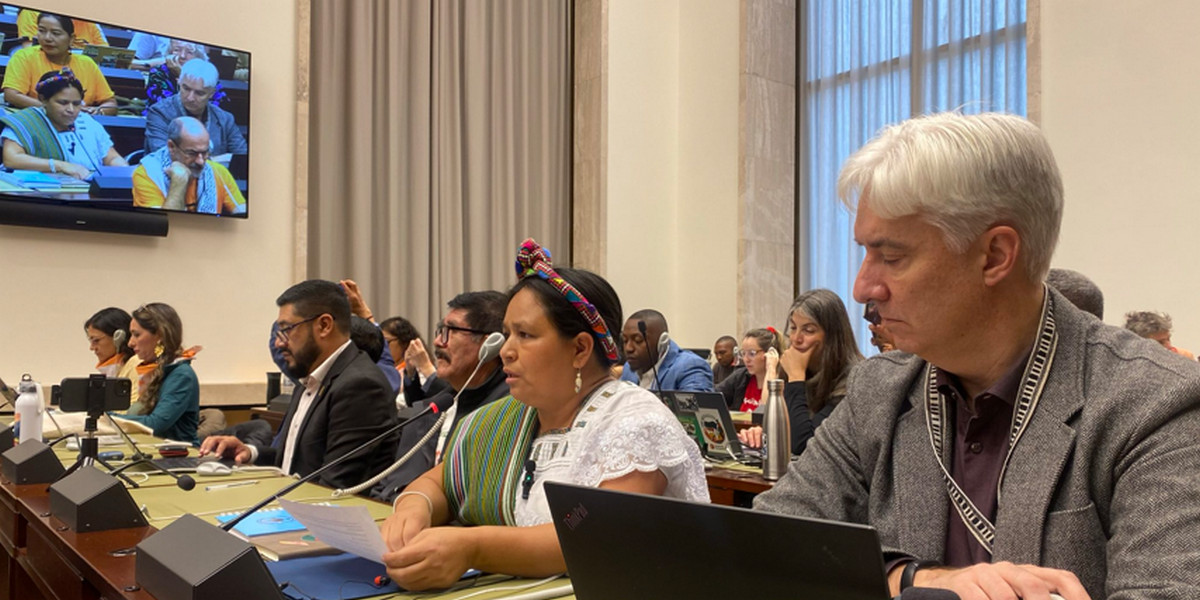
Cover photo: CIDSE delegation at 11th Session of the OEIGWG , Geneva 2025. Credit: CIDSE