

A cry from the Global South for integral agrarian reform
A message from the Latin American and Caribbean Episcopal Council (CELAM), the Symposium of Episcopal Conferences of Africa and Madagascar (SECAM) and the Federation of Asian Bishops’ Conferences (FABC) on the Occasion of ICARRD+20.
Updated on 9 April 2026
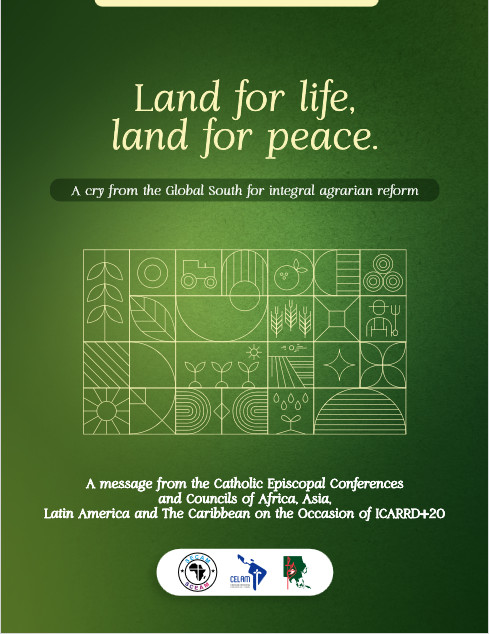
As part of its role to amplify the voice of the Catholic Church of the Global South on the importance of agrarian and climate justice issues, CIDSE has been supporting this initiative by the Catholic Episcopal Conferences and Councils of Africa, Asia, Latin America and the Caribbean. The message was released on the occasion of the International Conference of Agrarian Reform and Rural Development (ICARRD+20) in Cartagena/Colombia.
The Global South Catholic Church does not see the ICARRD+20 conference as an isolated event. In Cali (COP16), it spoke out about threatened biodiversity, and in Belém (COP30), it called for climate justice in the context of ecological debt. Today, it affirms that these struggles will be fruitless unless we address their common root: fair access to land and the rights of the rural population.
We are here to complete the circle. because there can be no peace with nature without resolving the structural sin of territorial dispossession and denial of rights.
CELAM, FABC and SECAM have come to ICARRD+20 to demand binding public policies and five immediate structural changes:
- Agricultural policies must be designed by peasants, pastoral communities and Indigenous peoples, including women. Furthermore, their implementation must be led by these sectors to guarantee their real power that allows them to establish priorities, propose solutions and promote the necessary transformations in their territories.
- There must be global regulations compelling companies to be accountable for the integral well-being of the territory, not merely for the carbon footprint resulting from their merchandise. Private profitability cannot externalise its costs onto the destruction of the community social fabric.
- Enough of measuring success by effort or allocated budgets. There must be physical metrics of agrarian justice. It is need to know how many hectares have actually been redistributed into peasant hands each year, how much has the volume of local food in territorial markets grown and who needs which land to meet their basic livelihoods and live with dignity. An audit of land, not of intentions, is required to give priority to those most need in the redistribution processes.
- Governments must stop viewing land and agrarian reform as an ideology of the past, and adopt it as the most efficient tool for the climatic future. In the effort for cooling the planet, financing land titling for Indigenous, Afro-descendant, pastoralist and peasant communities is cheaper and more effective than costly carbon capture technologies.
- Funds for climate and biodiversity must reach those who care for the land without intermediaries. Currently, financial bureaucracy consumes resources before they touch the ground. We demand direct transfer mechanisms to the territorial organisations of peasants and rural workers that guarantee food sovereignty.
Land governance cannot be designed behind closed doors; it must arise from a synodal listening and the active participation of those who put their bodies on the frontline for the defence of territories. Uniting our voice with that of popular movements and diverse communities that relate peacefully to the Earth is the only way to break political inertia.
Additional information
– The message was officially launched on 25 February at a press conference co-organised by CELAM, the Colombiana Social Pastoral Cáritas, the Archdiocese of Cartagena and CIDSE.
– On the same day, a statement by Faith communities at ICARRD+20 was also released. (EN – ES) open for signatures until 31st March 2026 via this link.
CIDSE contacts:
Manny Yap, Food and Land Policy Officer (yap(at)cidse.org)
Annia Klein, Communications Officer (klein(at)cidse.org)
Giorgio Gotra, Head of Operations and Communications (gotra(at)cidse.org)
Cover illustration: visual from the Global South Catholic Church message. Credit: CELAM.