
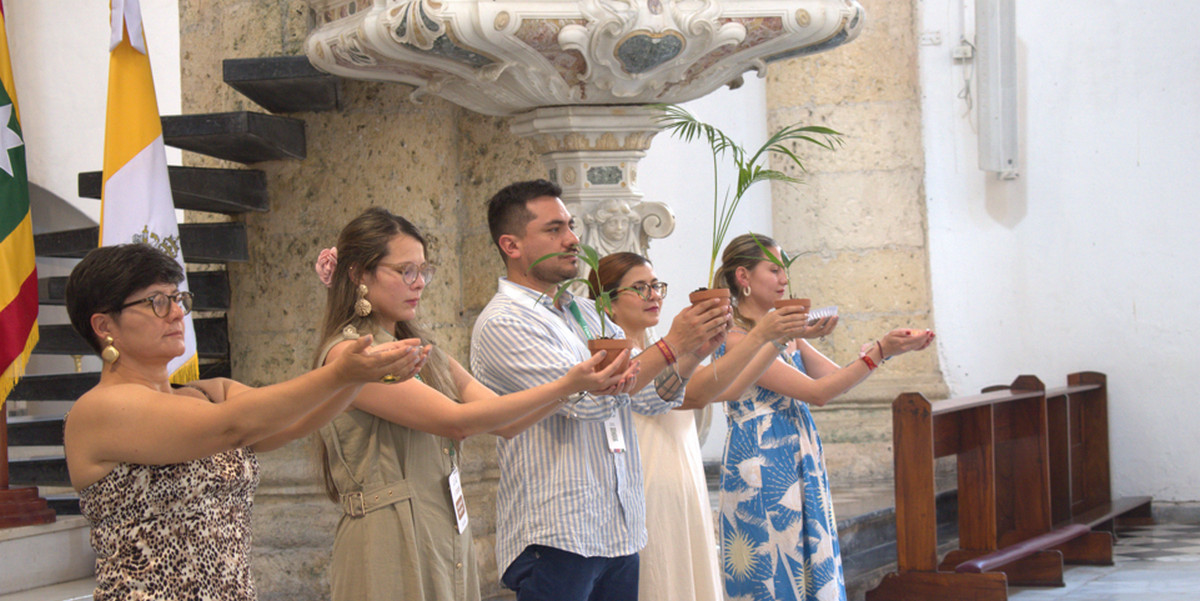
statement by Faith communities at icarrd+20

CIDSE, together with the World Council of Churches, Laudato Si’ Intercultural Association (Luxembourg), Caritas Internationalis and CELAM, the Latin American and Caribbean Episcopal Council released a statement in Cartagena, Colombia on the occasion of the International Conference on Agrarian Reform and Rural Development (ICARRD+20).
The statement is open for signatures through this link.
Deadline for signatures by organisations: 31st March 2026.
The statement calls on governments, international institutions, and the global community to take action on the following 9 points:
- Corporate Accountability: Establish binding international mechanisms to hold transnational corporations
accountable for human rights violations and environmental damage throughout their
global value chains - Constitutional Recognition of Land Rights: Enshrine the human right to land in national constitutions and legal frameworks, recognizing collective and customary land tenure systems alongside individual ownership models.
- Comprehensive Agrarian Reform Programmes: Adopt and implement binding public policies for equitable land redistribution that prioritize landless farmers, women, youth, and indigenous communities, supported by
adequate technical and financial support resources. The success of these programmes must be measured by auditable physical metrics, for example, the actual number of hectares redistributed to communities and the volume of local food produced, rather than merely by budgets allocated or policies drafted. - Elimination of Land Speculation: Condemn the financialisation of creation by establishing robust legal safeguards: against the financialization of agricultural land, restrictions on speculative investment that treat life-sustaining land as a mere asset, and regulation of large-scale land acquisition.
- Support for Agroecological Transition: Redirect agricultural subsidies from industrial agriculture toward agroecological practices that enhance biodiversity, soil health, and climate resilience while ensuring dignified livelihoods for farmers and pastoralists.
- Direct Community Funding: Create accessible financing mechanisms, including direct climate finance, that provide direct support to grassroots organizations, cooperatives, and communities engaged in sustainable food production and land stewardship.
- Participatory Governance: Guarantee meaningful and inclusive participation of affected communities— particularly women, youth, and Indigenous Peoples—in all policy processes related to agriculture, land use, and food systems.
- Linkage of land and water tenure governance: Inspired by the Voluntary Guidelines on the Responsible Governance of Tenure of Land, Fisheries and Forests in the Context of National Food Security (VGGT), fast track water tenure processes and Contribute to a global call to action linking land and water tenure within the post-ICARRD+20 framework, including through CFS (Committee on World Food Security).
- Protection of Land and Environmental Defenders: Implement robust legal protections for human rights defenders working on land and environmental issues, ending impunity for violence against rural leaders and
communities.
The time for incremental change and half-measures has passed. We want a profound restoration of the covenant between humanity and the earth. The harvest of justice cannot wait. We call upon all people of conscience to join us in advancing transformative policies that place human rights, ecological integrity, and the well-being of future generations at the center of global food and land policies. The future of our
planet and the well-being of future generations depend upon the courage we demonstrate today.
Additional information
– A cry from the Global South for integral agrarian reform, Message from the Latin American and Caribbean Episcopal Council (CELAM) on the Occasion of ICARRD+20. (EN – ES)
– The CELAM message and the faith communities’ statement were officially launched on 25 February at a press conference co-organised by CELAM, SECAM, FABC, the Colombiana Social Pastoral Cáritas, the Archdiocese of Cartagena and CIDSE.
– Click HERE to find out more about CIDSE activities at the ICARRD+20 conference in Colombia.
CIDSE contact:
Manny Yap, Food and Land Policy Officer (yap(at)cidse.org)
World Council of Churches contact:
Dinesh Sun, Programme Executive for Land, Water and Food Advocacy, (Dinesh.Suna(at)wcc-coe.org)
CELAM contact:
Cesar Piscoya, Asesor CELAM-CEPRAP, (ceprap.asesor1(at)celam.org)
Caritas Internationalis contact:
Musamba Mubanga, Senior Advocacy Officer of Caritas Internationalis, (mubanga(at)caritas.va)
Cover illustration: offering at mass in Cartagena during ICARRD+20 conference. February 2026. Credit CIDSE.