
EU & African NGOs re-launch joint Open letter for Farmers’ Freedom in Eastern and Southern African (ESA) Countries.
Open Letter, June 2025
The open letter, initiated by AFSA, Seed and Knowledge Initiative (SKI), Brot für die Welt, HEKS/EPER Swiss Church Aid and APBREBES, and co-signed by CIDSE and a broad coalition of civil society organisations from Europe and Africa, raises serious concerns about the European Union’s demand that five Eastern and Southern African (ESA) countries—Comoros, Madagascar, Mauritius, Seychelles, and Zimbabwe—adopt the 1991 Act of the International Convention for the Protection of New Varieties of Plants (UPOV 1991) as part of the ongoing Economic Partnership Agreement (EPA) negotiations. UPOV 1991 imposes strict limitations on farmers’ rights, including their ability to save, use, exchange, and sell farm-saved seeds and propagating materials—practices that are essential to smallholder livelihoods and agrobiodiversity.
NGOs from Africa and Europe are urging their governments to reject this provision. They argue that it exceeds the requirements of the World Trade Organization’s Agreement on Trade-Related Aspects of Intellectual Property Rights (TRIPS), representing a TRIPS+ obligation that undermines farmers’ rights and threatens the right to food.
The letter (also available in French) is open to signatures until 8 September 2025 via this form.
The signatories argue that:
- Adopting UPOV 1991 could undermine food security, biodiversity, and farmers’ right to participate in decisions affecting them.
- The system has proven ineffective in boosting innovation or seed diversity in existing UPOV 1991 contexts like OAPI.
- Most ESA countries are not members of UPOV, and some (like Zimbabwe) already have locally adapted seed laws.
- The EU is ignoring international human rights frameworks (e.g., ITPGRFA, UNDROP) by excluding farmers from negotiations and pushing a top-down model.
In June 2025, CIDSE co-organised two events in Rome, one with SECAM, AFSA, ESAFF together with its European civil society partners namely Misereor, DKA-Austria, Broederlijk Delen, CCFD-Terre Solidaire and Focsiv ahead of the 6th African Union – European Union Agriculture Ministerial Conference to demand urgent action on two critical issues: protecting farmer-managed seed systems and stopping the export of banned pesticides from Europe to Africa.
The other was held on 27 June at FAO Heaquarters organised by the African and European members of the Civil Society Engagement Platform Working Group on Food Systems during the 6th African Union (AU) – European Union (EU) Agriculture Ministerial Conference.
“Seeds of Peace and Hope,” the theme chosen by Pope Francis for the 2025 World Day of Prayer for the Care of Creation, is a reminder that caring for creation also means caring for those who cultivate it. In this Jubilee year and on the 10th anniversary of Laudato Si’, the call is clear: protect farmers’ rights to freely save, share, and plant their seeds. These rights are vital for preserving biodiversity, ensuring food security, and sustaining cultural heritage across generations.
List of Signatories:
Africa and Europe:
- Act Alliance EU
- African Centre for Biodiversity (ACB)
- Alliance for Food Sovereignty in Africa (AFSA)
- Association for Plant Breeding for the Benefit of Society (APBREBES)
- Biowatch South Africa
- Both ENDS
- Carolina Eco Green Economy
- CIDSE
- Convergence Globale des Luttes pour la Terre et l’Eau Ouest Africaine (CGLTE OA)
- DanChurchAid
- Future Ready Foundation SA (FRFSA)
- GRAIN
- HEKS/EPER Swiss Church Aid
- Living Earth (Namibia)
- LVC Southern and Eastern Africa
- Oxfam
- Participatory Ecological Land Use Management (PELUM) Association
- Polo de Competência em Agroecologia-Guiné-Bissau (PCAE-GB)
- Southern African Faith Communities Environment Institute (SAFCEI)
- SWISSAID
- The Eastern and Southern Africa small-scale Farmers Forum (ESAFF)
- The Seed and Knowledge Initiative (SKI)
- West African Committee for Peasant Seeds (COASP)
- ZAAB (Zambia alliance for agroecology and biodiversity)
Zimbabwe:
- Women and Land in Zimbabwe
- Women and Land in Africa
- Community Technology Development Organisation (CTDO)
- Participatory Ecological Land Use Management (PELUM) – Zimbabwe
- Participatory Organic Research Extension and Training (PORET)
- The Zimbabwe Smallholder Organic Farmers Forum (ZIMSOFF)
- Towards Sustainable Use of Resources Organization (TSURO) Trust, Zimbabwe
- ZIP-Fambidzanai Permaculture Centre, (FPC), Zimbabwe
- African Renaissance Sustainable Development (ARSD)
- Qunu Community Advice Centre (South Africa) QUCAC
Madagascar:
- Centre de Recherches et d’Appui pour les Alternatives de Développement – Océan Indien (CRAAD-OI)
- Femmes en Action Rurale de Madagascar (FARM)
- Réseau des Jeunes pour le Développement Durable (RJDD)
- Collectif pour la défense des terres malgaches – TANY
ADDITIONAL RESOURCES:
- Side-event “Stop the poison, Support the seed: a call for solidarity“, recording of side-event organised ahead of the 6th African Union – European Union Agriculture Ministerial Conference, 26 June 2025.
- Side-event “Achieving African Food Sovereignty: What Will It Take?“, Rome 27 June 2025.
- Joint Press Release “Stop the Poison, Support the Seed“, Brussels, 1st July 2025.
- “Protecting the seeds of life: Our duty to defend African farmers“, news article by Francesca Merlo on Vatican News with an interview from Manny Yap, Food and Land Officer at CIDSE.
CIDSE contact: Emmanuel Yap, Food and Land Policy Officer, CIDSE (yap(at)cidse.org)
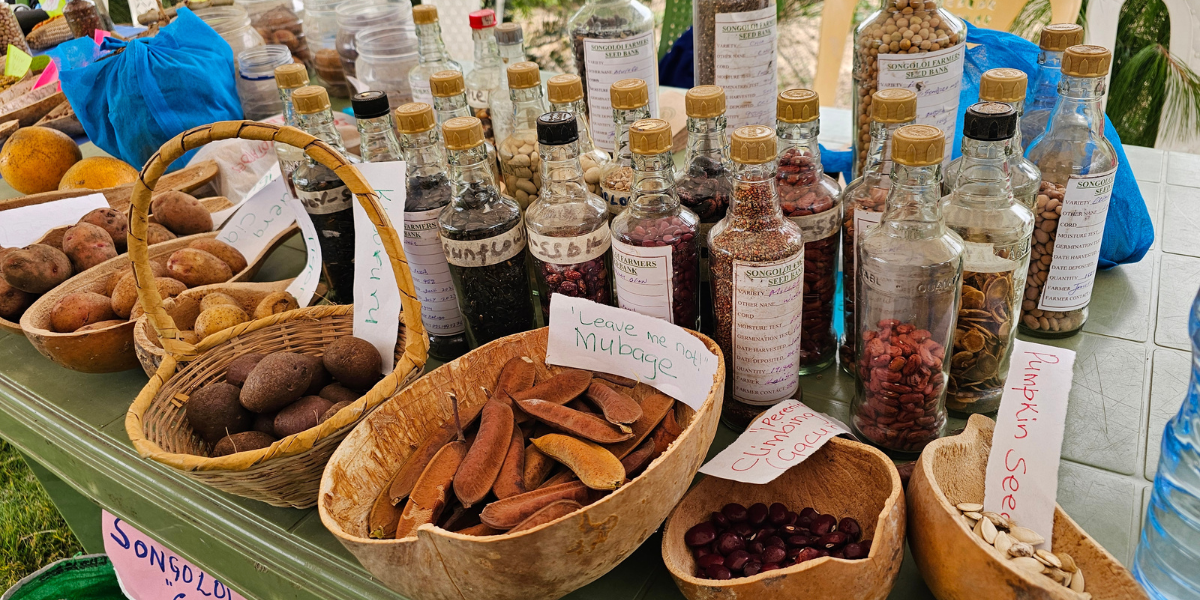
Cover photo: Farmers seed exhibition in Gilgil, Kenya, organised by Seed Savers Network (SSN). Credits: Susan Nakacwa.