
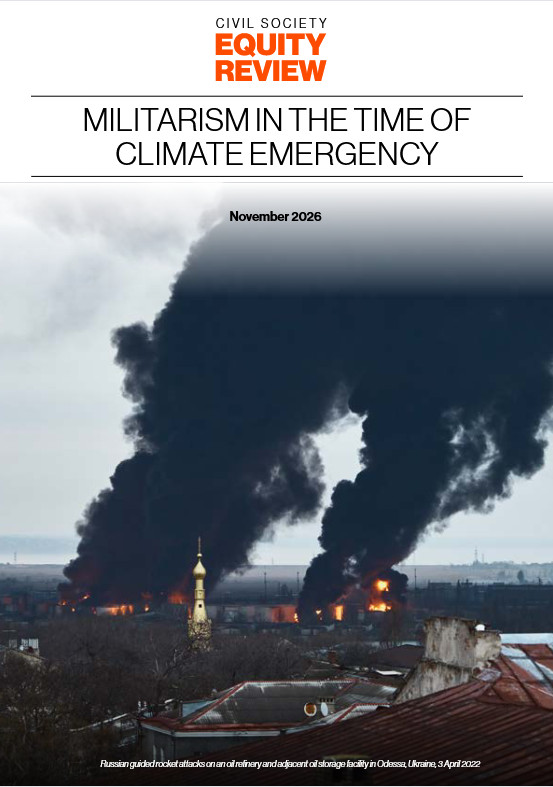
A Civil Society Equity Review of the Global Climate Regime, the Politics of Militarism and the Imperative of an Equitable Global Transition, November 2026.
The latest Civil Society Equity Review report, endorsed by over 320 civil society organisations, groups and social movements from around the world, including CIDSE, was released on 6 November. It will be officially launched at a side event on 12 November during COP31 in Antalya. The report examines how rising militarism, and geopolitical competition undermine the level of international cooperation needed to address the climate crisis.
Global military spending reached $2.9 trillion in 2025, diverting resources from climate finance, while military emissions—estimated at 5% of global annual greenhouse gas emissions—remain largely unaccounted for in national inventories. Meanwhile, war destroys ecosystems, weakens institutions and uproots communities, undermining climate resilience and leaving people more vulnerable to climate impacts.
Against this backdrop, the report provides:
- An analysis of the connections between militarism and the fossil fuel economy, highlighting how deeply fossil fuel extraction and consumption are intertwined with military power, geopolitical domination and competition over resources. It examines how militarism actively undermines climate action and international cooperation
- An updated analysis of the latest NDCs against their fair shares of the global mitigation effort, revealing that they are grossly inadequate to meet the 1.5C challenge and indefensible against any equitable effort sharing framework. Global north countries have failed drastically to meet their fair shares and provide climate finance to support global south countries.
- Evidence that responsibility for these shortfalls is deeply unequal within countries. The richest individuals have far higher per-capita emissions and far larger mitigation gaps than national averages reflect.
- A framework for a globally equitable phaseout of fossil fuel extraction and finds that extraction must be phased out by 90% in 2040. wealthy nations that are less dependent on fossil fuel extraction such as “the United States, Norway, Australia, and the UK, must end fossil fuel extraction by the very early 2030s. With those more dependent given more time.
CIDSE contact: Lydia Machaka, Climate Justice Policy Officer, machaka(at)cidse.org
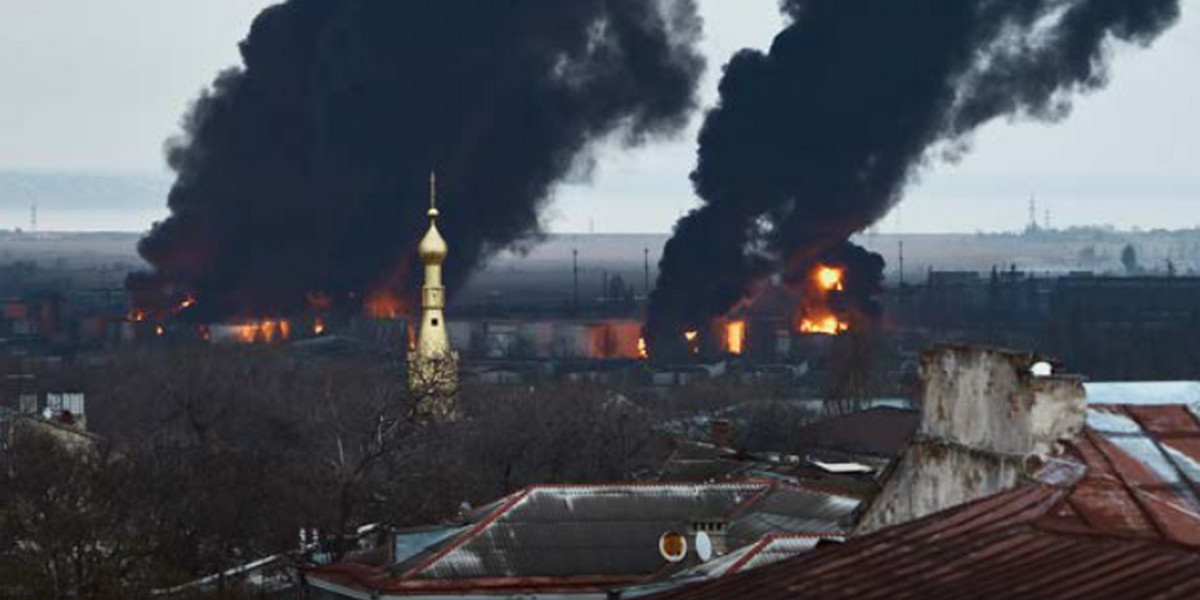
Cover image: Russian guided rocket attacks on an oil refinery and adjacent oil storage facility in Odessa, Ukraine, 3 April 2022. Credit: Alex Levitsky / Adobestock Image.