
Spanish text below
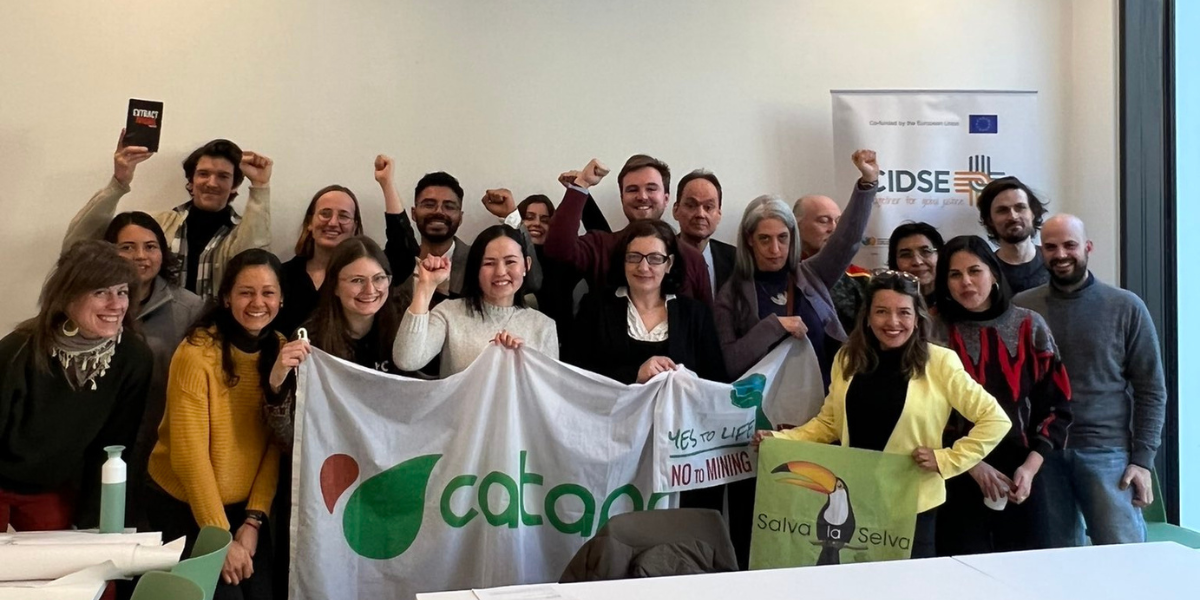
Danila Andagoya and Nathalia Bonilla welcome us as they prepare for one of the last activities that were part of the Right to Say No speaker tour in Europe, organised by CATAPA, EEB, Survival International and CIDSE. From 24 February to 9 March 2023, they attended different meetings and events together with human rights defenders from Switzerland, Chile and Indonesia, and met with various decision-makers interested to hear their experiences and concerns about the threats that poorly regulated extractive activities can have on their territories.
Both Danila and Nathalia are activists from Ecuador who work in Quito to resist mining activities in the territory of the Chocó Andino community, where Danila comes from. The Chocó Andino is a territory located about 45 minutes from the city of Quito which covers around 286,000 hectares. It has been recognised as a Biosphere Reserve by UNESCO for the incredible role that the forests of the Chocó Andino play in preserving the fauna that inhabits it: some 270 species of mammals, 30% of the bird species found in the whole of Ecuador and 15% of the plant species. “What I like most about my community is that we are used to sharing different things and we organise ourselves. We are always looking out for each other, and we have the confidence to express ourselves within the community” shares Danila.
However, this large nature reserve is threatened by the activities of mining concessions approved by the Ecuadorian government, in addition to illegal mining activities that encroach on the area. “In Ecuador, we have seen how oil companies, mining companies, and oil palm plantation companies have come and established in the towns and territories and on the land. They never asked if they could settle there, and this has caused great destruction. Their arrival was brutal and enforced. This has caused a lot of suffering, a lot of environmental damage”, explains Nathalia.
Around 12 metallic mining concessions have been granted by the Ecuadorian government, occupying 17.863 hectares and another 6 concessions are in process, occupying 9.899 hectares within the Chocó Andino Biosphere Reserve. “The energy transition causes that more minerals, more metals are required from the soil, and we are impacted in the way they try to enter our territories based on some promises, some activities like meddling in governments. So, it becomes an unsafe place for us”, reflects Danila.
People who are in a vulnerable position because of the extractive industries are also facing personal challenges inside their community: “The extractive sector is seen as a sector that employs mainly men, so men are established within the community”, says Danila, “(The money it produces) is also male money, because the men who work in the mines are the ones who decide about the economy of their families and the women will always be at home, taking care of the children”. Meanwhile, Natalia reflects: “It is very important to support the defense of the people, of the women who fight for nature because they are the actors who are putting their lives and their energies to stop extractivism. For example, I would like to mention the women’s network ‘Saramanta Warmikuna’, a network of Afro-Ecuadorian indigenous, smallholder women farmers. These women gather and start to work together for a different way of life. They also come together to connect with each other, to give more power to their demands; it’s also a space for sharing wisdom”.
During their visit to Europe, both activists spoke about the Right to Say No, a campaign that aims to prioritise the communities’ decision on the activities taking place in their territories, whether it is a positive or negative response. “The right to say no is very important (…) saying no for me means saying no to destruction, no to violence, no to death, no to colonialism, no to racism. At the same time, it means saying yes to my rights, yes to life, yes to other ways of relating to nature, yes to other kinds of different wisdoms”.
For more information, learn about the initiative “Quito sin Minería”.
SPANISH TEXT
Mujeres defensoras de los derechos humanos sobre la transición energética socialmente justa
Danila Andagoya y Nathalia Bonilla nos dan la bienvenida mientras se preparan para una de las últimas actividades que forman parte de la gira de oradores “El Derecho a Decir No” (Right to Say No, en inglés) en Europa, organizada por CATAPA, EEB, Survival International y CIDSE. Del 24 de febrero al 9 de marzo de 2023, asistieron a diferentes reuniones y eventos junto con defensores y defensoras de derechos humanos de Suiza, Chile e Indonesia, y se reunieron con tomadores de decisiones interesados en escuchar sus experiencias y preocupaciones sobre las amenazas que pueden tener las actividades extractivas mal reguladas en sus territorios.
Tanto Danila como Nathalia son activistas del Ecuador que trabajan en Quito para resistir las actividades mineras en el territorio de la comunidad Chocó Andino, de donde proviene Danila. El Chocó Andino es un territorio ubicado a unos 45 minutos de la ciudad de Quito, que abarca alrededor de 286.000 hectáreas. Ha sido reconocido como Reserva de la Biosfera por la UNESCO por el increíble papel que juegan los bosques del Chocó Andino en la preservación de la fauna que lo habita: unas 270 especies de mamíferos, el 30% de las especies de aves que se encuentran en todo el Ecuador y 15 % de las especies vegetales. “Lo que más me gusta de mi comunidad es que estamos acostumbrados a compartir cosas diferentes y nos organizamos. Siempre nos estamos cuidando y tenemos la confianza para expresarnos dentro de la comunidad”, comparte Danila.
Sin embargo, esta gran reserva natural está amenazada por las actividades de las concesiones mineras aprobadas por el gobierno ecuatoriano, además de las actividades mineras ilegales que invaden el área. “En Ecuador hemos visto cómo empresas petroleras, mineras y de plantaciones de palma aceitera han venido y se han establecido en los pueblos, y territorios, y en la tierra. Nunca preguntaron si podían establecerse allí, y esto ha causado una gran destrucción. Su llegada fue brutal y forzada. Esto ha causado mucho sufrimiento, mucho daño ambiental”, explica Nathalia.
Alrededor de 12 concesiones mineras de metales han sido otorgadas por el gobierno ecuatoriano, ocupando 17.863 hectáreas, y otras 6 concesiones están en proceso, ocupando 9.899 hectáreas dentro de la Reserva de la Biosfera Chocó Andino. “La transición energética provoca que se requieran más minerales, más metales del suelo, y nos impacta en la forma en que intentan entrar a nuestros territorios en base a algunas promesas, algunas actividades como la intromisión en los gobiernos. Entonces, se convierte en un lugar inseguro para nosotras”, reflexiona Danila.
Las personas que se encuentran en una posición vulnerable debido a las industrias extractivas también enfrentan desafíos personales dentro de su comunidad: “El sector extractivo es visto como un sector que emplea principalmente a hombres, por lo que los hombres están establecidos dentro de la comunidad”, dice Danila, “(El dinero que produce) también es dinero masculino, porque los hombres que trabajan en las minas son los que deciden sobre la economía de sus familias y las mujeres siempre estarán en casa, cuidando a los niños”. Mientras tanto, Nathalia reflexiona: “Es muy importante apoyar la defensa del pueblo, de las mujeres que luchan por la naturaleza, porque ellas son las protagonistas que están poniendo su vida y sus energías para detener el extractivismo. Por ejemplo me gustaría mencionar a la red de mujeres ‘Saramanta Warmikuna’, una red de mujeres campesinas indígenas afroecuatorianas que se reúnen y comienzan a trabajar juntas por una forma de vida diferente, también se unen para conectarse entre ellas, para darle más poder a sus demandas; es también un espacio para compartir sabiduría”.
Durante su visita a Europa, ambas activistas hablaron sobre el Derecho a Decir No, una campaña que busca priorizar la decisión de las comunidades sobre las actividades que se desarrollan en sus territorios, ya sea como respuesta positiva o negativa. “El ‘Derecho a Decir No’ es muy importante (…) decir no para mí significa decir no a la destrucción, no a la violencia, no a la muerte, no al colonialismo, no al racismo. Al mismo tiempo, significa decir sí a mis derechos, sí a la vida, sí a otras formas de relacionarnos con la naturaleza, sí a sabidurías diferentes”.
Para más información, conoce la iniciativa “Quito sin Minería”.
Credits Cover photo: CATAPA