
How much longer will Israeli settler imports go on?
Remark:
This article by Andrew Rettman and Elena Sánchez Nicolás was originally published in the EU- Observer on 22 May 2026.
Food and wine from Israeli settlers is still flowing into European shops directly from the West Bank front lines — but Israel risks losing Italy’s protection from EU sanctions.
EU consumers are eating AdaFresh’s edible flowers, Carmel oranges, Hadiklem dates, and Jordan River Herbs from Israeli settler firms in Palestine’s occupied West Bank, for instance.
They are also drinking Psagot, Shilo, and Zion wines from the West Bank, as well as Golan Heights and Tishri wines from Israeli annexed Syrian territory.
These were among some 45 settler firms who exported agricultural produce and construction equipment to the EU, according to the Coopération Internationale pour le Développement et la Solidarité (CIDSE) group in Brussels and the Israeli WhoProfits research centre.
Israeli settlement exports to the European Union
An interactive overview of some companies operating in occupied territories (West Bank, Jordan Valley, and Golan Heights) and their confirmed trade routes to EU member states.
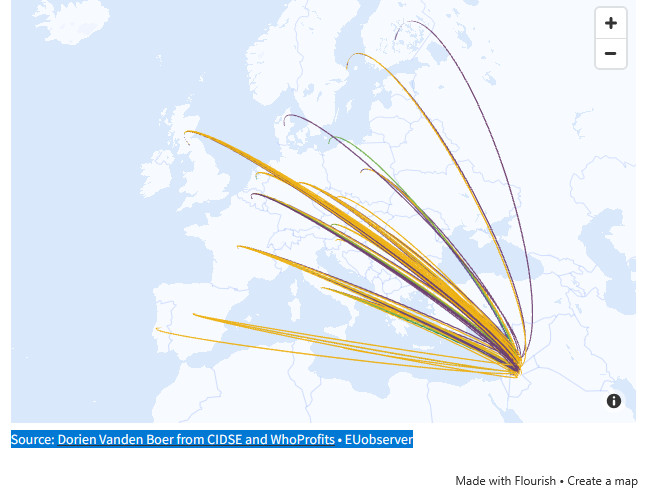
NB: Click on this link to access the interactive overview.
Total EU trade in goods with Israel grew to €43.3bn in 2025, up from €42.6bn in 2024, despite the Gaza war.
The European Commission was contacted to ask how much of this was trade from illegal Israeli settlements, but did not reply.
EU officials previously told EUobserver it was a “marginal” figure, estimated at less than €250m a year.
But the settlers’ edible flowers and wines were flowing to EU shops directly from what has turned into a battlefield, posing ethical questions for European consumers.
Israeli colonies were also expanding at record rates, stifling EU and UN plans for a two state solution, and giving Europe’s trade with settlers a strategic importance despite its symbolic size.
Strategy and symbols
“[Israeli prime minister Benjamin] Netanyahu and Israelis more generally expect impunity to proceed with their policies in the Occupied Palestinian Territories and the wider region,” said HA Hellyer from the Royal United Services Institute (RUSI) think-tank in London.
“The long held ambition of Netanyahu and the Israeli right has been to get the world to accept Israel’s permanent hold on the West Bank and treat the illegal settlements as normal,” said Martin Konecny from the European Middle East Project (EuMEP) group in Brussels.
On the ethical front, there were some six attacks a day in the West Bank in 2026, in which settlers fired live ammunition at Palestinian families, and burned homes, cars, and olive groves according to the UN.
Israeli soldiers and settlers have killed 47 Palestinians in the West Bank so far this year.
And post mortem reports on Palestinian prisoners in Israeli jails cited by a UN
special rapporteur on 19 May spoke of “rib fractures, haemorrhages on the skin and internal organs, and lacerations of intra-abdominal organs”.
There were also dozens of “incidents of sexual torture,” said the rapporteur, Alice Jill Edwards.
But despite this, settler exports were ending up in shops even in member states which wanted the EU to ban them in order to chill Israeli aggression.
Spain was doing business with seven settler Israeli firms, for instance: Agrifood Marketing, Arava, Aqwise Wise, Carmel, Field Produce, Hadiklaim, and Hamat Group.
Belgium (AdaFresh flowers), France (Adanim tea), the Netherlands (Hadiklaim
dates), Portugal (Filed Produce peanuts), Slovenia (Arava fruit), and Sweden (Golan Heights wine) also imported settler products.
Israel’s own goal
For their part, EU trade ministers meeting in Brussels on Friday (22 May) had
planned to discuss the Iran war’s impact on the single market.
The Czech foreign minister, Petr Macinka, had already told Israeli foreign minister Gideon Sa’ar in Prague on Wednesday he would veto any further EU
blacklistings of extremist settlers, which required an EU-27 consensus.
But Israeli national security minister Itmar Ben Gvir’s actions on Thursday meant that ministers would probably discuss listing him, as well as a recent Franco Swedish proposal to ban settler imports, EU diplomats said.
Ben Gvir filmed himself degrading prisoners, including EU nationals, from a Gaza aid flotilla, prompting international condemnation.
Italian prime minister Giorgia Meloni has also shielded Netanyahu from the settler import ban, which needed a qualified majority vote (QMV) in the EU Council.
The QMV is a voting mechanism used in the EU, where a decision requires the
approval of 55 percent of member states representing at least 65 percent of the total EU population to pass.
But if Meloni changed her mind the QMV would fly and the Italian mood was
moving ever closer to a tipping point, said Nathalia Tocci, a professor of EU politics at the Johns Hopkins University in Washington.
“The Israeli government, just like [US president] Trump, is becoming increasingly toxic in public opinion. So Meloni may be forced to budge eventually,” Tocci told EUobserver.
“A far right Italian government tragically only reacts to Italians being mistreated, which is why this [flotilla incident] is having such resonance now in Italy,” she said.
“The recent uproar around Ben Gvir’s abuse of international activists means nothing without actual consequences,” RUSI’s Hellyer also said.
‘Settler’ shop labels mostly not implemented
Meanwhile, the fact EU consumers, even in Israeli critical societies such as Italy or Spain, were still buying settler imports, was not due to apathy, said CIDSE’s Dorien Van Den Boer.
They were not being helped by the fact most European shops did not implement an EU court ruling from 2019 that settler products should be clearly labelled as such.
The EU retail-label code was being widely ignored, according to investigations by Israeli +972 Magazine and German daily Frankfurter Rundschau in January and February.
But “European citizens continue to protest the inaction and double standards of their leaders when it comes to Israel,” Van Den Boer said.
“Ending trade with the Israeli settlements is not a boycott of Israeli or Jewish
products, not even a sanction, it is about ensuring that the EU’s trade policies
comply with international law”, she said.
Barry Andrews, a liberal Irish MEP who toured the West Bank earlier in May, also said: “As Israel strives to make Palestinian economic life unviable, we need to make the illegal settlements economically unviable. In this, the EU is both mandated and protected by international law to do so”.
In moral terms, a settler import ban would “draw a line on occupation, ethnic
cleansing, apartheid, showing Europe is no longer willing to bankroll that,” said
Claudio Francavilla, from the Human Rights Watch group.
And in political terms, “ending settlers’ access to the world’s largest market [the EU] would strike a major blow to Netanyahu’s vision,” said EuMEP’s Konecny.
‘It’s about making a puncture in his ‘Greater Israel’ strategy,” he said.
CIDSE Contact: Dorien Vanden Boer, Israel & occupied Palestinian Territory Policy Officer, vandenboer(at)cidse.org
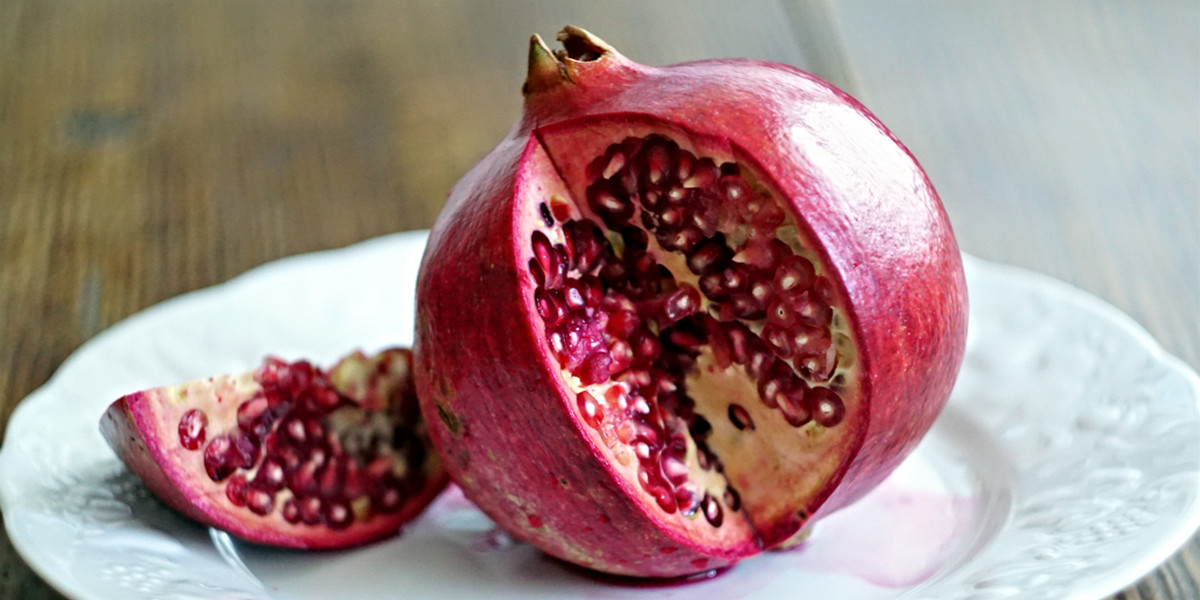
Cover image: Pomegranates are one of the main Israeli settler exports: Credit: Creative Commons.