
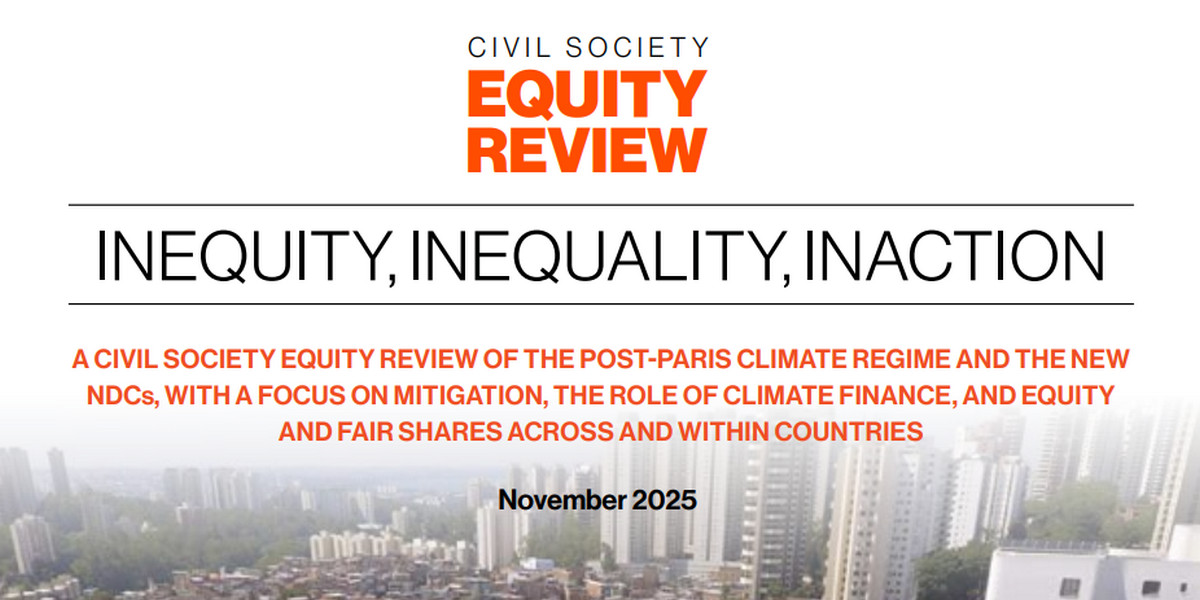
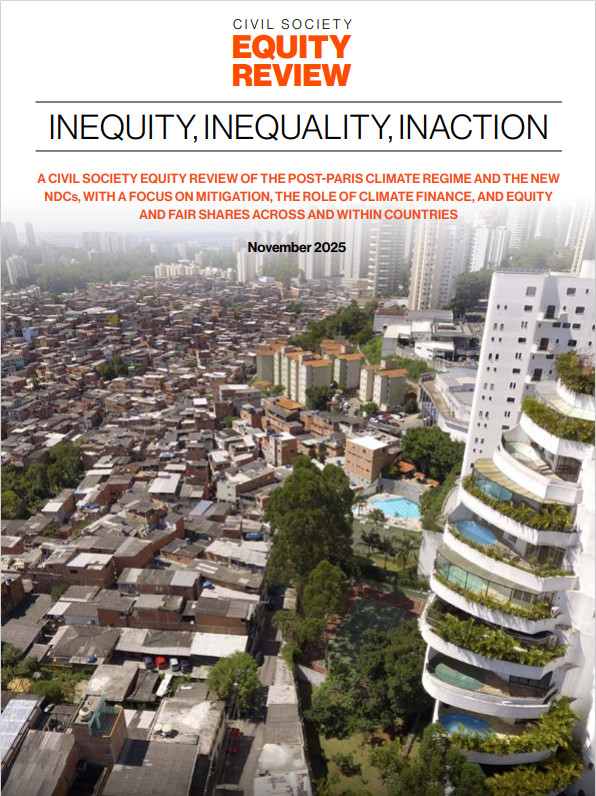
A civil society equity review of the post-Paris climate regime and the new NDCs, with a focus on mitigation, the role of climate finance, and equity and fair shares across and within countries, November 2025.
The latest Civil Society Equity Review report, endorsed by over 350 civil society organisations, groups and social movements from around the world, including CIDSE, was released on 12 November, at a side event during COP30 in Belém . It assesses the ambition and fairness of the new round of NDCs submitted by Parties ahead of COP30; reviews the last 10 years of Civil Society Equity Reviews, and explains why and how international fairness and inequality within countries are linked. The verdict is stark: three decades after the Rio Earth Summit and a decade on from the Paris Agreement, governments are still protecting profits over people – shielded by elite capture and fossil-fuel disinformation. Climate cooperation is breaking down, and COP30 must deliver a fair-shares reset rooted in justice, not greed.
The report shows that Global North countries have failed to cut emissions and are still expanding oil and gas, while also failing to deliver promised finance. The global finance system is failing too: instead of providing public funds at the scale needed, it traps many countries in debt and dependence. While the Global South is closer to meeting its fair share, it still needs to take more effective climate action but is all too often held back by this debt and lack of funds.
Climate cooperation is paralysed, and global goals will remain out of reach unless COP30 delivers a reset – moving from loans to grants, from profit-driven finance to public support that enables countries to invest in clean energy, resilience, and jobs.
The document also warns that inequality within countries is driving the crisis. The global rich can shield themselves from many climate impacts while pushing the costs of transition and disaster onto workers and overstretched public systems. This elite capture – particularly by fossil fuel interests – of crucial political processes is deepening injustice, fuelling political paralysis, and blocking the stronger action needed to keep us within climate limits. This paralysis extends to militarised conflicts that divert trillions from climate action – COP30 must redirect those resources to peace and genuine multilateral cooperation.
COP30 must confront this political reality with a new climate realism – one that pushes ahead with rapid transformative change anchored in equity, justice, and cooperation. Climate failure isn’t about a lack of ambition – it’s about injustice. COP30 must prove that ambition and justice are not opposites but inseparable: only fair shares can unlock the scale of action needed.
The report identifies three breakthroughs COP30 must achieve:
- An examination of the danger of developed countries falling so far short of their fair shares, especially their unwillingness to engage with climate finance discussions on the needed scale of trillions not billions,
- Discussion that the money for climate finance is available and several areas for possible funding,
- The need for system change, with reforms divided between the short term and the long term, needed in order to fully transition away from the fossil fuel addicted and increasingly inequitable society we have today.
Source: “Inequity’s deadly hold: COP30 must resist political capture and prioritise people over profits“, Press release, 12 November 2025
Cover image: Contrasts of inequality – The Favela do Paraisópolis, the biggest urban slum in São Paulo, is right next to Morumbi, a neighborhood with high-rising comfortable residential buildings for wealthier residents.
Credit: Caio Pederneirasl / Shutterstock.